Do something for me before I say anything else. Take a piece of floss and run it along the gumline of your back teeth, top and bottom, then look at it. If there is any pink on that floss, or you catch a faint metallic taste, your mouth is bleeding right now.
Almost everyone shrugs at that. The gums bleed a little, you rinse, you move on, you have done it your whole life. I want to change how you see it in the next few minutes, because that small pink stain is not small, and it is not nothing.
Healthy gums do not bleed. Not when you floss, not when you brush, not ever. Bleeding gums are an open wound sitting inside the warmest, wettest, most bacteria rich place in your body. And through that wound, some of the most dangerous microbes we know of get a free ride straight into your blood.
Bleeding is a wound, not a habit
We have been taught to read bleeding gums as a brushing style problem. Too hard, wrong angle, stiff bristles. Sometimes that is part of it. But healthy tissue does not tear and weep because you touched it. Your fingertip does not bleed when you rub it. Neither should your gum.
When a gum bleeds, the tissue is already inflamed and broken down. That is the very first visible stage of gum disease, and it has a gentle name, gingivitis, that makes it sound like a minor thing you outgrow. It is not minor. It is the beginning of a process that, left alone, eats the seal between your teeth and your body.
Here is the reframe I want to land, and I want it to sit on its own. A bleeding mouth is not a mouth that needs a softer toothbrush. It is a mouth with an open door.
Enamel is the hardest thing your body makes, and they drill through it anyway
Put your tongue on your front teeth. That surface is the hardest substance your body produces, harder than bone, and it is the only tissue you have that cannot repair itself once it is gone. Bone knits. Skin closes. Enamel does not come back.
Now think about what a cavity actually is. It is a hole. Something drilled through the hardest material you are made of, and it was not a drill, it was bacteria.
Here is the mechanism, and it is worth knowing because it is the same mechanism the rest of this article is about. Streptococcus mutans eats sugar. It ferments it, and the waste product it makes is acid. That acid sits against the tooth in the sticky film of plaque, and it dissolves the mineral out of your enamel. Not quickly, not dramatically, just constantly. Research in the Journal of Dental Research showed that sucrose specifically is what lets these bacteria build that sticky scaffold in the first place, and the microbiology of plaque and caries has mapped the whole process. Sugar in, acid out, mineral gone. A cavity is not bad luck and it is not soft teeth you inherited. It is a bacterial waste product eating a hole in you.
So sit with that for a second, because it is the whole point of this article delivered early.
These organisms take apart enamel. The hardest, most mineralized, most defended surface in your entire body. It takes them years, but they get through it, and your dentist drills out the damage and fills it and nobody ever asks the obvious next question.
What do you think they do to the soft stuff?
Because your gut lining is not enamel. Your artery walls are not enamel. Your brain is not enamel. There is no mineralized armor on any of it, and the bacteria in your mouth are not politely staying in your mouth, which is exactly what the rest of this article is about to show you. A mouth is not a sealed room. It is the top of the tube that runs through the middle of you, and it drains into your blood every time your gums bleed.
And now the part that should really land. The thing that makes them aggressive is the thing most of us eat all day. Sugar is the fuel. It is what they ferment, it is what they build their scaffold from, and it is what turns a manageable population into a thriving one. You are not just feeding yourself at every meal. You are feeding them, and they eat first.
I want to be straight with you about what this does and does not mean, because I am not going to hand you a claim I cannot stand behind. Clearing the bacteria out of your mouth does not make sugar good for you. It never was. Sugar still feeds candida in your gut, it still drives the inflammation this whole site is about, and a clean mouth does not buy you a pass on it. What clearing them does is stop you handing a hostile population a free meal five times a day while it works on the hardest tissue you own.
Where the door leads
Picture the gumline as a border wall between the outside world and your bloodstream. In a healthy mouth, that wall is sealed. In an inflamed mouth, it is cracked open, and right on the other side of it runs your circulation.
This is not a theory. Researchers took people with gum inflammation and simply had them brush their teeth, then drew their blood. In a study published in Circulation, an ordinary act of toothbrushing pushed oral bacteria into the bloodstream. Not surgery. Not an extraction. Brushing. When the barrier is broken, the everyday friction of a normal day becomes a delivery system.
So the question stops being whether bacteria are getting in. In a bleeding mouth, they are. The question becomes which bacteria, and what they do once they are inside.
Meet the red complex
Your mouth holds hundreds of species, and most of them are fine or even helpful. But a small group of them are genuinely dangerous, and decades ago a landmark study in the Journal of Clinical Periodontology mapped how the bad ones cluster together. The most destructive cluster got color coded red, and the name stuck. The red complex.
Three names lead it: Porphyromonas gingivalis, Treponema denticola, and Tannerella forsythia. Of these, Porphyromonas gingivalis is the one to know. It is a stealth pathogen. It does not just sit there and feed. It produces a set of enzymes called gingipains that chew up tissue, scramble your immune signaling, and help it hide from the very defenses sent to kill it. It is a bacterium that manipulates the body it invades.
That is what is crossing the threshold in a bleeding mouth. Not a harmless mouth germ. An organism built to break down tissue and evade your immune system, now loose in your blood.
And the red complex does not work alone. Sitting just underneath it is another cluster the same research color coded orange, bacteria like Fusobacterium nucleatum and Prevotella intermedia. The orange complex is the advance team. It moves in first, inflames the gum, and builds the exact low oxygen, bleeding conditions the red complex needs to take hold, which is why the two are almost always found together. If the red complex is the demolition crew, the orange complex is the one that pries the door open for them.
If you have never heard a word of any of this from your own dentist, you are not alone, and it is not your fault. This is genuinely cutting edge science. I recently sat in the chair of a biological dentist, one of the more forward thinking ones out there, and even he did not know what the red complex was. It usually takes fifteen to twenty years for new research to travel from the journals into the hands of the average practitioner, and far longer for the ones who stopped staying curious a long time ago. So do not wait for the system to catch up to your mouth. You can know this now.
Your arteries and your brain
Here is the part that should get your attention, and I am going to be careful and honest about exactly what the science says, because this is where it matters most.
Once these bacteria are circulating, they do not politely stay away from your organs. Investigators who opened up atherosclerotic plaque, the fatty, dangerous buildup inside diseased arteries, went looking for periodontal bacteria and found them living there. That work in the Journal of Periodontology identified these gum pathogens inside the artery walls themselves. The bugs from a bleeding mouth were found at the scene of heart disease.
And then the brain. In 2019, a team published a study in Science Advances reporting that Porphyromonas gingivalis and its gingipain enzymes were present in the brains of people who had died with Alzheimer's disease, and that the more gingipain they found, the worse the markers of the disease. They argued it may be an active driver, not just a bystander, and they began testing molecules to block those enzymes.
Read that again. The same bacterium that lives in a bleeding mouth turns up inside diseased arteries and inside the brains of people with Alzheimer's. That is not a coincidence you want to shrug off, and it is a connection almost nobody is checking for. I am not a doctor and I am not diagnosing you from a blog, but I will tell you plainly that your mouth and your most important organs all share the same bloodstream, and what lives in one gets to the others.
The map: where these bacteria have actually been found
Here is the whole map, not just the two famous stops.
Every line below is a study that either found the organism sitting in the tissue, or found that people carrying it got sick more often. Read down it and watch how few names there are. The same short list of bacteria, organ after organ. That is what made me stop thinking of my mouth as a dental problem.
The oral bacteria map
Every circle is a link. Tap one to open the study on PubMed.
The organisms
Some studies measured a panel of periodontal organisms rather than a single species. In those rows, every organism the panel covered gets a circle pointing at that study.
Look at where every line on that map starts. The same place. And it is the one place on the whole list you can actually see, measure, and change, with a saliva sample and a nightly routine. That is the good news buried in all of it. You cannot reach into your own arteries. You can absolutely reach into your mouth.
So stop guessing. Order the Oral Microbiome Profile on the labs page and know in a couple of weeks exactly what you are carrying.
The mouth and the gut are the same tube
There is one more path these bacteria take, and it connects this whole conversation to your digestion. You swallow. All day, every day, you swallow what is in your mouth, and it lands downstream in your gut. And the sheer volume is hard to believe. Every single milliliter of your saliva carries hundreds of millions of bacteria, and you swallow well over a liter of saliva a day, which sends hundreds of billions of bacteria down your throat and into your gut before you have eaten a single thing. If those are the wrong bacteria, you are dosing your gut with them all day long.
When researchers fed Porphyromonas gingivalis to animals, it changed the gut itself. A study in PLoS One found that swallowed P. gingivalis shifted the gut bacterial balance and weakened the gut barrier. Your mouth is the front door to your entire digestive tract, and a mouth full of the wrong bacteria quietly seeds the gut below it.
And those bacteria bring something with them. The outer wall of a gram negative organism is built from a molecule called LPS, and once the gut barrier below is loose, LPS crosses into the blood and keeps going. Researchers have now measured it in people with twenty one different conditions. I mapped the whole chain, what raises it, how it gets out, and everywhere it has turned up, and it opens right here without taking you off this page.
This is exactly why, in the candida world, the mouth is the piece almost nobody checks. The red complex and candida actively protect each other. In a study in Scientific Reports, Porphyromonas gingivalis and the yeast built a shared biofilm that shielded the bacteria and made the whole colony far harder to kill, and that same partnership runs across the red complex. The yeast throws up a scaffold the bacteria hide inside, the bacteria shelter the yeast in return, and together they become nearly impossible for your immune system or an antifungal to fully clear. So if you have been fighting candida in your gut and it will not go down, an inflamed mouth carrying these bugs and reseeding it from above is one of the first hidden reasons to rule out. I wrote about that whole loop in how to starve candida and rebuild your gut. And if clearing it has ever left you feeling worse instead of better, that is candida die-off, and it has its own playbook.
The deeper danger, your own immune system
There is a bigger reason a leaky barrier matters, and it is the one that turns this from a dental problem into a whole body one. When that barrier is broken, at your gumline or, even more so, in a leaky gut downstream, it is not only bacteria that slip into your blood. Partly digested food proteins get through too, proteins that were never meant to reach your bloodstream intact.
Your immune system meets those loose proteins in the blood, does not recognize them, and correctly attacks them as invaders. So far so good. But here is where it turns on you. Some of those food proteins look almost identical to the proteins that build your own organs and glands, your thyroid, your joints, your nerve tissue. Immunologists call it molecular mimicry. Your immune system, now trained to attack that shape, cannot tell the difference, and it starts attacking the matching tissue in your own body by mistake. This is one of the best described roads into autoimmune disease. Dr Alessio Fasano, who discovered the protein that controls this leakiness, laid out how a leaky barrier drives autoimmunity, and other research has shown how antibodies to common foods cross react with human tissue.
And here is the cruel part. As long as you keep eating that food, you keep feeding the confusion. Every bite retrains the immune system to attack, it keeps hitting both the food and the tissue of yours that resembles it, and the cycle never closes on its own. This is why a breached barrier, in your mouth or your gut, is never a small thing. It can quietly turn your own defenses against you, and closing the door starts with sealing the barrier and pulling out the foods that keep the fire lit.
First, see what you actually carry
Before you change a thing, get a real picture, because you cannot manage what you cannot see. You do not have to guess whether you carry the red complex. You can measure it.
An Oral Microbiome Profile maps the bacterial community in your mouth from a simple saliva sample, including the periodontal pathogens. It is the same logic as testing your gut instead of guessing. You find out which bacteria you are actually dealing with, you do the work, and then you retest and watch the picture change. Test, do not guess. You can order it through the labs page with the rest of a functional workup.
How to close the door
Here is the plan, and I want you to feel how much of it is free or cheap and doable starting tonight. We go from the free daily habits up to the medical option you only reach for when you have to.
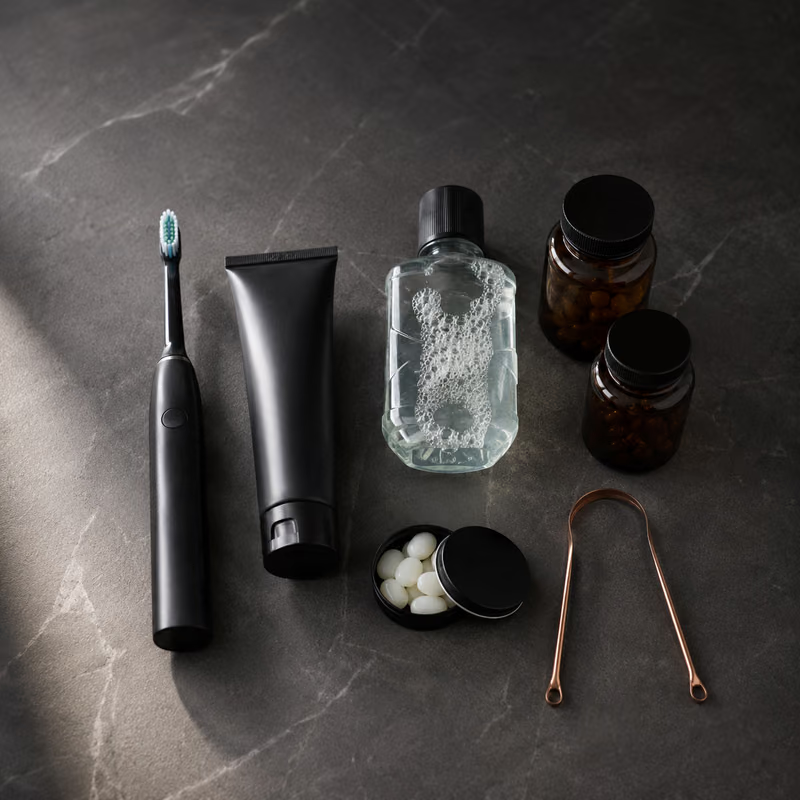
- Floss like it matters, tonight, but not with just any floss. A toothbrush cannot reach where the red complex lives, which is below the gumline and between the teeth, so flossing is the single highest leverage free thing you can do, and most people skip it. One real caution though. Do not use the thin, hard, sharp flosses that saw into already inflamed gum tissue and make the bleeding worse. I use DrTung's Smart Floss, the gentlest floss I have ever found, because it stretches and spreads out to clean wide and soft instead of cutting. Floss every night, gently.
- Scrape your tongue. The back of the tongue is a reservoir where these bacteria hide and regroup. A tongue scraper each morning lifts the coating that feeds them. Free habit, few dollar tool.
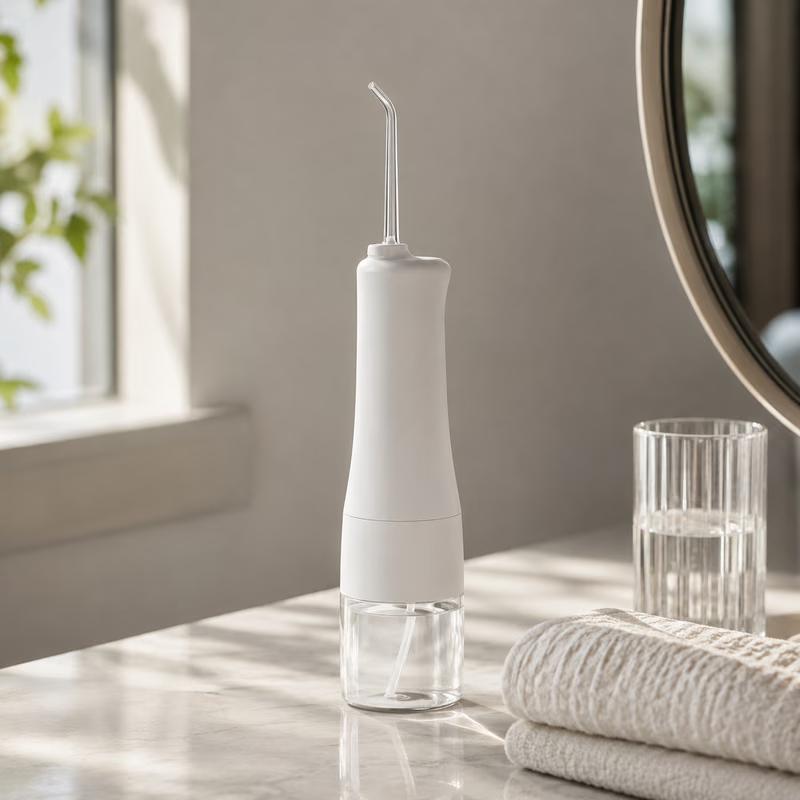
- Add a water flosser. For flushing below the gumline and around the pockets where bacteria colonize, a water flosser reaches what string cannot. This is the cheap upgrade that punches above its weight.
- Rinse every day, just not with a killer. A gentle rinse absolutely belongs in your daily routine. SuperMouth nano hydroxyapatite and Lumineux are the two I run, because they rebuild the mouth instead of stripping it, and you can use them for life. The weapon is a separate thing. If your profile shows the red complex, a zinc rinse is the tool while you clear them, because zinc kills oral bacteria directly, and the day your retest is clean it comes out. Full sequence further down. And never the alcohol stuff, which gets its own section.
- Reseed the good bacteria. You do not just want a scorched mouth, you want a healthy community that crowds the bad ones out. Oral probiotics like ProBiora and the BLIS K12 and M18 strains in Hyperbiotics Pro Dental are built for exactly this, along with Smile Guard lozenges that target plaque and sore gums. Rebuild the garden, do not just salt the earth.
- Rebuild the enamel, gently. Nano hydroxyapatite is the same mineral your enamel is actually made of, so the SuperMouth toothpaste and the SuperMouth rinse remineralize the surface instead of stripping it. It is the reseed-and-rebuild philosophy applied to the tooth itself.
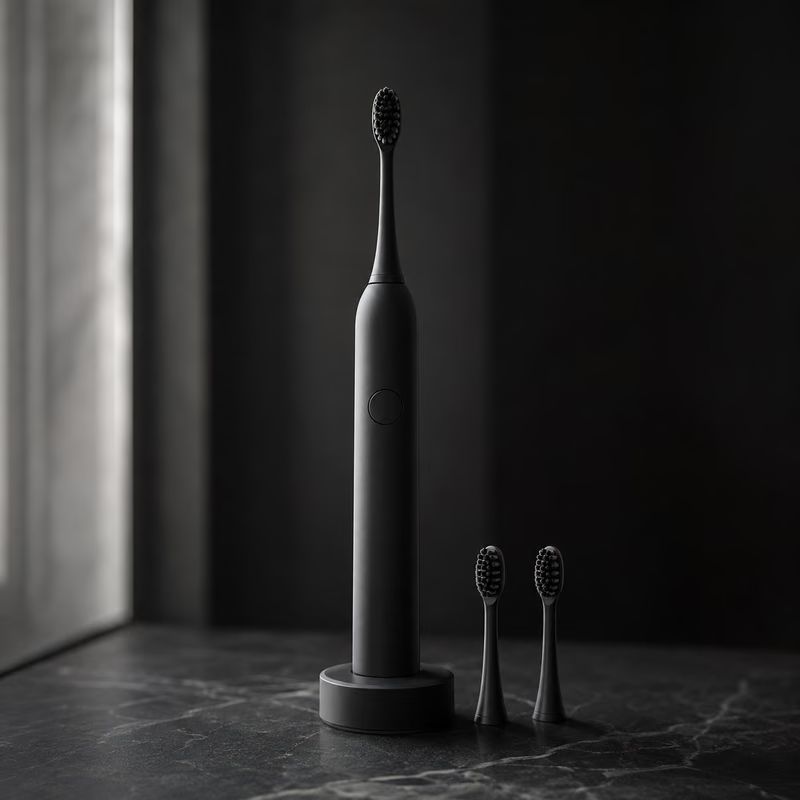
- Do it as one system. I put the whole routine together as the Oral Health Bundle: the two oral probiotics, the lozenges, a sonic toothbrush, the nano hydroxyapatite paste and rinse, the gentle Lumineux daily rinse, the zinc rinse for the clearing phase only, floss, a water flosser, a tongue scraper, and the Oral Microbiome Profile lab so you can measure before and after. It is the exact set I ran. Rebuild the mouth, do not nuke it.
None of that has to happen this week. But tonight you can floss, scrape your tongue, and swap your rinse. That alone starts to close the door.
Why I threw out the alcohol mouthwash
If you take one product off your bathroom shelf after reading this, make it the alcohol based mouthwash. It is one of the worst things you can do to your mouth while calling it hygiene.
Start with what it actually is. The most famous one was formulated back in the 1800s as a surgical antiseptic, and long before it was ever sold for your breath it was marketed as, among other things, a floor cleaner and a treatment for gonorrhea. That is not a smear, that is its own history. You are gargling a disinfectant.
And a disinfectant cannot read labels. It does not kill only the red complex, it carpet bombs your entire oral microbiome, the beneficial bacteria included, the exact ones that hold the bad species in check. Wipe them out every morning and you leave the whole field open for the aggressive bugs to grow back first.
Here is the connection almost nobody makes. Some of those good oral bacteria have a critical job. They take the nitrate from the vegetables you eat and turn it into nitric oxide, the molecule that relaxes your blood vessels and keeps your blood pressure down. Studies found that an antiseptic mouthwash wipes out that blood pressure lowering effect, and that these nitrate reducing oral bacteria play a real role in controlling blood pressure. Kill them off and your blood pressure can climb. And that very same nitric oxide is what the body needs to get and keep an erection, the identical pathway the little blue pill works on, so gargling those bacteria away is a quiet, unglamorous way to work against your own blood flow in the place you would least want to.
And it gets more serious than that. Alcohol is a recognized carcinogen, and here you are holding it against the thin, delicate tissue that lines your mouth. Research has shown that even a thirty second rinse with alcohol is toxic to the cells of your mouth, and that alcohol mouthwashes drive the kind of gene changes seen in pre cancerous oral tissue. You are pouring a solvent over the most vulnerable lining in your body, twice a day, for decades, and calling it fresh breath.
So here is the whole rule in one line. A gentle rebuilding rinse every day for life, a targeted zinc rinse only while you carry the red complex, and the alcohol mouthwash in the trash for good.
The hard truth about the red complex
Now the part I would rather not have to tell you, but I will, because I always will. Sometimes the home routine is not enough, and I am not going to pretend it always is.
Once the red complex is truly entrenched in deep gum pockets, brushing and rinsing at the surface cannot reach it, and neither can most of the natural approaches people try first. A good biological dentist has to physically clean below the gumline. And for aggressive cases, the periodontal research is uncomfortably clear about what it takes. A systematic review and meta-analysis in the Journal of Periodontology found that adding two specific antibiotics together, amoxicillin and metronidazole, to that deep cleaning cleared these bacteria far better than the cleaning alone, and a later network meta-analysis that ranked every adjunctive antimicrobial against each other put that same pairing first, still ahead at twelve months. That is the point. These bacteria are resistant enough that most things only push them down for a while and they repopulate. That combination is the one shown to keep them gone. It is often a course of roughly one to two weeks.
I do not love that answer. Antibiotics come at a real cost to your gut, and I would always rather rebuild an ecosystem than carpet bomb it. But I am not going to hand you a claim I cannot stand behind, and the honest state of the science is that for a dug-in red complex infection, that combination paired with the mechanical cleaning is what actually works. That is a conversation for you and a good biological dentist, and it is never something to self prescribe. If you go that route, rebuild the gut and the oral microbiome hard afterward with the probiotics above.
What this protocol did in my own mouth
I do not tell you to do things I have not done, so let me open my own chart.
I ran the Oral Microbiome Profile on myself. It came back carrying red complex and orange complex, which is what most people's comes back carrying. I had no symptoms. My dentist had never mentioned it. It took a saliva sample to see it.
Here is what I ran: two oral probiotics, ProBiora and the BLIS K12 and M18 in Hyperbiotics Pro Dental. A sonic toothbrush. A water flosser with warm water and a little Lumineux and Oxyfresh zinc in the reservoir. Nano hydroxyapatite toothpaste. Floss, tongue scraper, and the SuperMouth rinse.
Then I retested. Red complex gone, below the limit of detection, all of it. The one orange complex organism still hanging around had dropped to a small fraction of where it started, well inside the healthy range.
No antibiotics. No scraping. Just the routine, run the way it is meant to be run.
And I am not the impressive case here. I have watched this change things for people who walked in far sicker than I ever was.
Kill, confirm, repopulate
Three phases. Almost everyone does phase one and stops, which is why almost everyone ends up back where they started.
Phase one, kill. The zinc rinse goes in the water flosser reservoir with warm water, twice a day. That detail is the whole trick. A rinse you swish and spit touches the surface for thirty seconds, and the red complex does not live on the surface, it lives down in the gum pocket where a swished rinse never reaches. The flosser drives the same solution under pressure straight into that pocket. Same product most people already own, completely different result.
Phase two, confirm. Retest. Around ninety days is the usual window, and the test tells you when you are done, not the calendar. Light cases clear faster. Deeper ones take longer and need a good biological dentist too.
Phase three, repopulate. The zinc comes out, of the cup and the reservoir both. Warm water in the flosser, the gentle rinses only, and the probiotics run hard to fill the ground you just cleared. Take them at night after you brush, last thing, nothing to eat or drink after, so they settle on a clean surface and actually colonize.
One thing to expect, because it sounds alarming until you understand it. Clearing the red complex takes your good bacteria down with it. Of course it does. Nothing walks into a gum pocket, kills four specific organisms, and leaves the neighbors alone. You are clearing ground, and ground clears. That is exactly why phase three exists and why it is not optional. An empty mouth is the halfway point, not the finish line.
Eight years since my last cleaning
I had not been to a dentist in eight years. Not once.
The dentist and the assistant looked in my mouth and were genuinely shocked. Their words, near enough, were that it looked like I had a cleaning about six months ago.
Then they went to work. Probing every pocket, measuring, scaling, the whole deep clean. And my gums did not bleed. Not once, not anywhere. From the way the two of them reacted, I do not think they see that.
Go back to the very top of this article, because that is the loop closing. Healthy gums do not bleed. Not when you floss, not when you brush, and not when someone runs a metal probe down into the pocket and scrapes under your gumline. That is the hard version of the test, and almost nobody passes it. Most people cannot even pass the floss version.
That is not luck. That is what happens when you eat well and actually run a real routine every day. Your mouth is a living system, and tended right it does most of the maintenance itself. Most people run a diet that builds plaque all day and then pay someone twice a year to scrape off the consequences.
Then the part that made me laugh. They said my teeth were white, and I eat every single thing dentists tell you not to, every day. Tea. Dark chocolate. Blueberries. Blackberries. The exact staining list, and I do not whiten.
Here is what almost nobody connects. Those foods are loaded with polyphenols, and polyphenols are not neutral in a mouth. Green tea catechins have been shown to protect gum tissue from Porphyromonas gingivalis invasion and to interfere with how it sticks and behaves, and polyphenol intake shifts the microbiome and its short chain fatty acids in a good direction. And a stain does not sink into enamel, it clings to the film and plaque sitting on top of it. Sugar is what grows that plaque. So I was starving the layer that holds the colour while eating the foods that were quietly doing my mouth a favour.
And here is the part that should stop you. My teeth looked good. My gums did not bleed under a probe. Every visible sign in my mouth said healthy, and I was still carrying red complex and orange complex. That is exactly why you test instead of judging this in a mirror. The mirror told me everything was fine, and the mirror was wrong.
Get your pockets measured, and ask for the ultrasonic
If your profile shows red or orange complex, get in a good biological dentist's chair before you start.
Ask them to measure your pockets. They walk a small probe around each tooth and read the depth in millimeters, it takes a few minutes, and it tells you something saliva cannot: how deep this has already gone.
That number decides the procedure, and the general rule is simple. Pockets of 1 to 3 mm get gingival treatment. Pockets of 4 mm and greater need scaling and root planing. The whole point of either one is complete biofilm disruption, so know your number and make sure the treatment you are getting actually matches it.
Then ask for ultrasonic scaling. Your flosser delivers solution into a pocket, but it cannot break hardened deposits off a root surface. That is mechanical work and it is the scaler's job. The two do different halves of the same task.
And start the protocol at least a day before that cleaning, not after. The hours right after a scaling are the most open window your mouth will ever have, and whoever is standing there takes the ground. Show up cold and you hand that window to whatever was already living in you.
Why I took the antibiotics
I cleared my mouth without them, and I still chose to run fourteen days of amoxicillin and metronidazole together.
My reasoning was simple. Clearing my saliva told me what was in my saliva. It did not tell me what had already left through my gums, and this whole article is about these organisms not staying in the mouth. I would rather clear the whole body once than spend years wondering.
That pairing is not random, and this is the part worth understanding. These organisms do not sit on a surface waiting to be wiped off. They build a biofilm and live inside it, a shelter that makes them genuinely difficult therapeutic targets, which is why they shrug off rinses and products and come back after a cleaning like nothing happened. When researchers ranked every adjunctive antimicrobial against each other across twenty one randomized trials, amoxicillin plus metronidazole came out first, and it was still ahead at twelve months. That is the whole difference. Everything else knocks them down and waits for them to repopulate from wherever they were hiding. This is the one combination shown to still be holding a year later. It is also a carpet bomb, so two things matter. No alcohol while you are on metronidazole, that combination makes people genuinely sick. And rebuild afterward, gut as well as mouth, harder than you think you need to.
It is a prescription, so it is a conversation for you and a good biological dentist or a good functional medicine doctor. I am telling you what I chose, not handing you a plan.
Tell whoever you are kissing
Nobody says this out loud, so I will. These bacteria move between people.
A systematic review of people sharing a household found Porphyromonas gingivalis shared between them, and earlier work on spouses tracked it passing between partners down to the matching strain type. Saliva is saliva. Kissing, a shared drink, a shared fork.
So you can clear your mouth completely and get reinfected by the person you love, who has no idea they carry anything because they have no symptoms either. I did not.
Tell your partner. Ask them to test and run the protocol beside you. Not as an accusation, nobody chose this. Do it because clearing one mouth in a two mouth house is bailing out one side of a boat.
And it does not stop at your partner. These bacteria pass to your kids. Researchers have matched the Streptococcus mutans in a child's mouth to their mother's strain, and early childhood cavities track with which of her genotypes the child picked up. The periodontal organisms move the same way, shared right across a household.
Now sit with what that means. Heart disease runs in the family. Alzheimer's runs in the family. Diabetes runs in the family. We say it meaning genes. But a family also shares saliva for eighteen straight years. The forks. The kisses. The toothbrush cup. So look back at that map and ask an honest question. How much of what runs in your family is written into your DNA, and how much of it is just living in everybody's mouth, handed down at the dinner table like a recipe?
And it is not even a clean split between the two, which is the part that really got me. These bacteria do not just sit next to your genes. They reach into how your genes get read. Researchers have documented DNA and RNA methylation changes in periodontal disease, epigenetic control of the inflammation itself, and gum cells changing which inflammatory signals they pour out depending on how a bacterial challenge has methylated them. There is even work on epigenetic memory in gum tissue, a record the tissue keeps of what it has already been through.
Your DNA is the sheet music. Methylation and the small RNAs decide which parts get played and how loud, and these organisms have their hands on that. So you may not have inherited a disease at all. You may have inherited a set of bugs that spent your whole childhood turning the volume up on genes you were always carrying anyway.
I am not telling you that explains it. I am telling you it is a variable, a big one, and it is one nobody is checking. And a gene you cannot change and a bacterium you can are two very different inheritances.
Your mouth is the gate
You are not a set of teeth that happens to have a body attached. Your mouth is the gate to your bloodstream, your heart, your brain, and your gut, all at once, and it has been talking to you about its condition every time you saw pink on the floss and looked away.
Your body is not broken. It is blocked. And for a startling number of people, one of the quietest, most overlooked blocks of all is a low grade infection in the mouth, seeping into the rest of the body a little more with every swallow, while they wonder why they feel inflamed and cannot find the source.
Close the gate. Test what you carry, do the daily work, and bring in a good biological dentist if it runs deep.
One more thing, and it is the reason there is a second half to this story. Everything here has been about the soft tissue, the gums and the bacteria living on them. But some of the most serious mouth problems are not on the surface at all. They are hidden inside your teeth and buried in your jawbone, invisible on a normal dental checkup, and they need a different kind of dentist to even find them. That is where we go next, in what is hiding in your jaw.
Look at the floss. Then go close the door.