Hold your hand up to a bright light and look at the deep red glow coming through the edges of your fingers. That red is light passing straight through your skin and into the tissue underneath. Your cells have been drinking that part of the spectrum from the sun since the day you were born.
Red light therapy is just a way to give them a focused dose of it on purpose. And once you understand what it actually does inside you, the long list of benefits stops looking like hype and starts looking like exactly what you would expect.
The one sentence that explains all of it
Red light therapy works by charging your mitochondria, the tiny energy engines inside almost every cell you have, and because so much of your body runs on those engines, the benefits reach far past skin, into muscle, brain, eyes, mood, and more.
Hold onto that sentence. Everything else in this post hangs off it.
What the light actually does inside you
Red light therapy has a real name, photobiomodulation, and a real, well-mapped mechanism. Certain wavelengths of red and near-infrared light pass into your tissue and get absorbed inside your mitochondria, the engines that turn food and oxygen into usable energy, a molecule called ATP.
The main absorption site is an enzyme called cytochrome c oxidase. A review of the mechanisms of photobiomodulation describes how light absorbed there helps release nitric oxide that had been putting the brakes on that engine, which lifts the mitochondria's output and lets the cell make energy more freely. More available energy, in a cell that was running short.
That is the honest core of it. Not a magic ray. A nudge to your cells' own power plants.
Follow the logic all the way down
Here is the part the cautious articles never finish, and it is the most important idea in this whole subject.
Your mitochondria are the common denominator of your entire body. Your skin runs on them. Your muscles run on them. Your brain, which is about two percent of your weight and burns twenty percent of your energy, runs on them enormously. Your eyes, especially the retina, are some of the most energy-hungry tissue you own. Almost nothing in you works without mitochondria making the power.
So follow the logic. If a cell is struggling because its mitochondria are starved, running the engine against a headwind, then giving those mitochondria more energy lets the cell do its job again. That is not a cure claim. That is just how cells work. And it means the benefits of red light are not a random grab bag of unrelated promises. They are exactly what you would predict from one root mechanism: wherever energy-starved cells are holding a tissue back, more cellular energy tends to help.
The research is filling that prediction in, tissue by tissue. That is why the list is long. Not because someone is overselling a gadget, but because the mechanism is that fundamental.
What the research actually reaches
Let me show you the breadth, with the evidence, so it is not just a nice theory.
Skin is the home turf. A controlled trial of red and near-infrared light had people use the light over weeks against an untreated control group, and the treated groups showed visible improvement in fine lines, wrinkles, and skin roughness, with a measured increase in collagen density. Real, measured, gradual.
Muscle and recovery. A systematic review and meta-analysis found photobiomodulation supports muscle performance and eases the fatigue that comes with exercise. It is why red light sits in the same drawer as the sauna and the cold plunge for me.
Brain and cognition. Near-infrared light aimed at the head, deep enough to reach brain tissue, is a real and active research field. A review of photobiomodulation for the brain walks through the work on cognition, mood, and recovery, all downstream of the same mitochondrial mechanism in some of the most energy-hungry cells you have.
Free Gift
THE 3 BIOHACKING DEVICES JESS WILL NOT LIVE WITHOUT
Plus the free 3 Dantiens guided meditation. Drop your email.
Mood. In the same vein, a pilot randomized trial of transcranial photobiomodulation tested near-infrared light as a treatment for major depression. Early, but promising, and it points exactly where the mechanism says it should.
Eyes and aging vision. This is the one most people are told to avoid, and the research says the opposite. In a controlled study of deep red 670nm light, brief morning exposure improved aging vision, color contrast, and low-light sensitivity, in adults over 40. The retina is packed with mitochondria, they decline with age, and the right light appears to help them. There is a safety rule here that matters, and I cover it in the next section.
Hair. Low-level light has randomized controlled trial support for regrowth in pattern hair loss. Same story, energy to follicle cells that were fading.
None of this makes red light a cure for anything, and I am not going to pretend it does. What it makes it is a genuine, mechanism-first tool with a benefit list that is broad for a reason.
The eye rule almost nobody tells you
Because the eye research is real, people start pointing panels at their faces. Read this before you do.
You never gaze into a bright, high-power full-body panel. Those are built to flood a lot of tissue from a distance, and staring into one is a real hazard to your eyes. The eye research does not use anything like that. It uses low doses of gentle deep red, specifically 670nm, at low power.
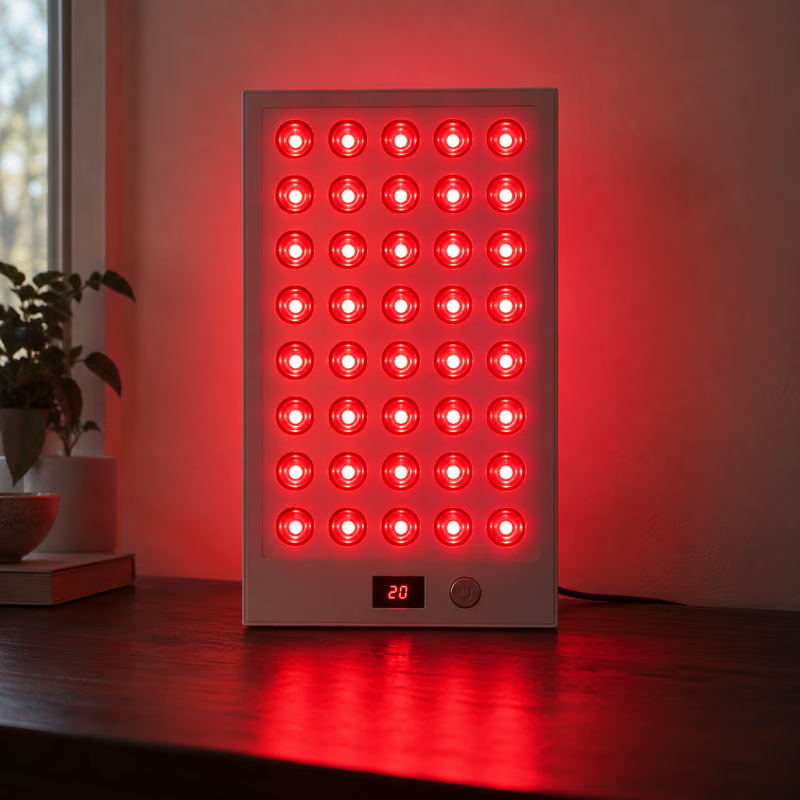
So if you want the eye benefit, you use a panel made for it. A small, low-power 670nm panel with diffuser lenses, the kind you can comfortably look toward for a few minutes in the morning. The GembaRed Vector is the one I use for exactly this, and it is a completely different tool from the full-body panel I point at my skin and muscles. Two panels, two jobs, and you never confuse them.
660 and 850 are two different tools
On a full-body panel you will see two numbers, 660nm and 850nm, and they are two different jobs, not marketing.
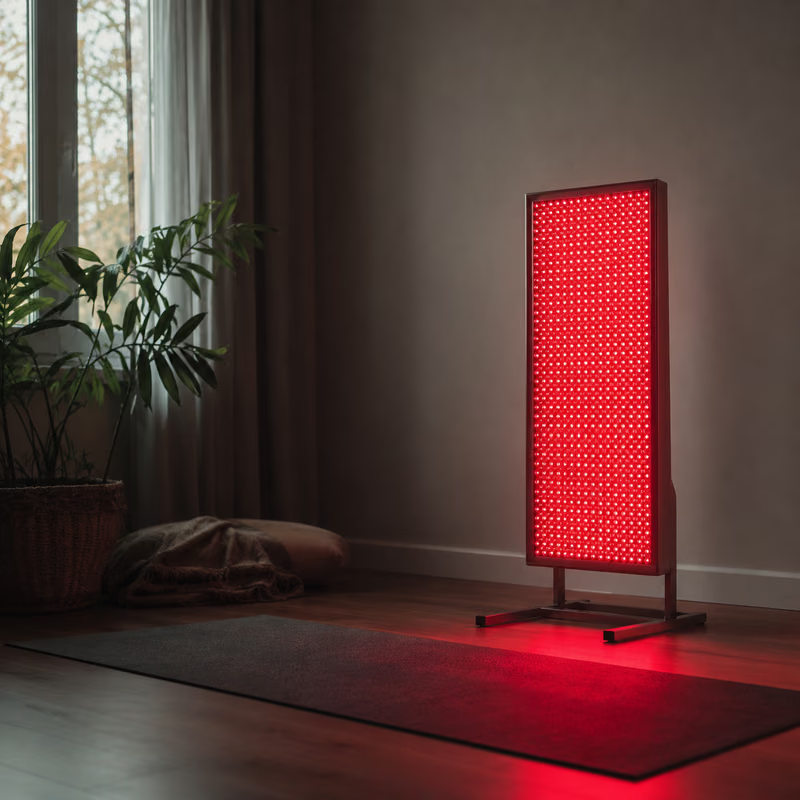
660nm is red light you can see, absorbed closer to the surface, which makes it a fit for skin. 850nm is near-infrared, invisible and deeper-reaching, so it is aimed at muscle, joints, and tissue below the surface. A good full-body panel gives you both so you are not forced to choose a depth. Eye gazing is separate, done with the dedicated 670nm panel above, never the bright full-body one.
How I actually use it
Here is the ladder, from the free version all the way up, so nobody feels priced out of the useful part.
- Start with the free version. Morning sunlight on your skin and eyes is the original red and near-infrared exposure, and it costs nothing. If you do one light thing for your health, get outside early. A panel is a supplement to the sun, not a replacement for it.
- Full-body panel for skin, muscle, and joints. A few times a week, red toward skin and near-infrared toward what you trained, on the panel I use. Follow the maker's distance and time, because with light, more is not automatically better.
- A dedicated eye panel for a short morning gaze. A few minutes toward the GembaRed 670nm panel built for eye use, never the bright full-body one.
- Be consistent for weeks. The effects are cumulative. A steady habit beats one dramatic session every time.
None of this has to happen this week. But this morning you can walk outside and get the free version of the exact spectrum a panel is trying to imitate.
The honest boundary
Red light therapy is low risk for most healthy people when used as directed, and it still has real cautions. Never stare into a bright panel, use the eye protection that comes with it, and keep eye gazing to a low-power panel made for it. If you take medication that raises light sensitivity, have a condition affecting your eyes or skin, or are pregnant, check with a good functional medicine doctor first. It is a support tool that works alongside good medical care, and anything persistently wrong in your body still belongs with a good functional medicine doctor.
Your body is not broken. It is blocked. And sometimes the block is simply that your cells are running their engines against a headwind, low on energy, low on light, doing their jobs at half power. A little of the right wavelength, on top of the sunlight you were built for, can help clear that path. The light is the assistant. Your mitochondria are the ones doing the work, in every tissue you have.
Point the big panel at your skin and your muscles, gaze into the little one made for your eyes, keep it modest, and let the weeks do the talking.