A while back I wrote about why I sit in a sauna almost every day. Cold is the other side of that coin, and it is the one people quit fastest, usually for the wrong reason. They think the point is to suffer, to prove something, to white knuckle their way through three brutal minutes. It is not. The cold is a tool, and like heat it works because of what the body does in response to it, not because of how much it hurts.
Let me make the case for the plunge.
Cold is the other half of hormesis
The instinct is to treat comfort as healthy and stress as harmful. The body does not work that way. It adapts to challenge. A small, controlled dose of stress tells it to repair and come back stronger, and a life with no challenge at all leaves it soft. This is hormesis, and it is the logic underneath exercise, fasting, heat, and cold.
Heat and cold are not opposites so much as two doors into the same room. Both are a brief, deliberate stress. Both ask the system to respond and then settle a little more resilient than before. If the sauna is the warm version of that bargain, the cold plunge is the sharp one, and the sharpness is part of what makes it work.
What the cold does to you in the first minute
When cold water hits you, a lot happens fast. Your blood vessels clamp down, your heart rate jumps, your breath catches, and your body releases a flood of noradrenaline, the chemical behind focus, alertness, and a lifted mood.
This is not a small effect, and the exact temperature matters more than the toughness. In a study on the human response to immersion in water of different temperatures, researchers compared water at 68 degrees Fahrenheit and at 57 degrees, and only the colder one did anything dramatic. At 57 degrees, plasma noradrenaline climbed about 530 percent and dopamine about 250 percent. At 68 degrees, the surge barely registered. So there is a real threshold here, and it is not as cold as you think. The switch flips somewhere around 57 degrees, roughly the upper 50s, which is exactly why you do not need ice. That response explains most of what people feel when they get out: clear headed, awake, strangely calm. You are not imagining the shift, you can measure it.
What the research actually shows
The findings are real, and they stack up in your favor.
A 2025 systematic review and meta-analysis of cold water immersion pulled together the randomized trials and found that cold immersion improved sleep quality and lowered stress. The stress drop shows up in the hours after a plunge rather than the second you step out, so think of it as a tune-up for your whole day, not a quick fix for a bad moment. There is a brief rise in inflammation right after, and that is not a bug, it is the point. That spark is the hormetic stress your body adapts to and comes back stronger from.
The most practical finding comes from a large randomized trial on cold showering and health, where people who finished their showers with thirty to ninety seconds of cold for a month took about 29 percent fewer sick days than the control group. A free habit, a measurable result.
How to start tonight with nothing but your shower
You do not need a plunge tub, an ice machine, or a frozen lake, and you do not need it icy either. The clearest research used a plain cold shower, and so should you to begin. Aim for genuinely cold, water around 60 degrees Fahrenheit, and down into the low 50s is plenty, held for about thirty seconds a day. Do that most days for a few months and you get most of what an ice plunge would give you, without the ice and without the expense.
If you are brand new and even a straight cold finish feels like too much, start with contrast instead. Go warm, then cold for fifteen to thirty seconds, back to warm, then cold again, three or four rounds, and always end on cold. Bouncing back and forth is far easier to talk yourself into than one unbroken block of cold, and the shower makes it effortless, you just turn the dial. Hot, cold, hot, cold is the gentlest on-ramp there is, and it quietly builds your tolerance until a plain cold finish feels easy.
- Splash your face and neck first. Before you turn the shower fully cold, splash a handful of the cold water on your face and the back of your neck. That fires the body's calming dive reflex before the main event, so the full cold lands with a lot less shock. This one trick is the difference between dread and doable.
- Then turn it cold. End your shower on thirty seconds of cold. That is a real dose, not a warm up, and it does not need to be ice, just genuinely cold.
- Breathe through it, do not hold. The cold makes you want to gasp and clench. Instead, breathe slowly and let your shoulders drop. Controlling the breath is half the skill.
- Build slowly. Add time as it gets easier, but thirty to ninety seconds is plenty. Cooler water means you need even less.
- Be consistent. A short cold finish most days does far more than one heroic plunge you never repeat. Thirty seconds a day for a few months is where the real change lives.
And if you ever want more than your shower gives you, do not go buy a four-figure plunge tub, they are mostly a rip-off. Get in a cold river or lake instead, carefully and never alone, or fill a cheap stock tank in the yard. The cold does not care what it came in. The habit is the whole thing.
Let me tell you how I learned to respect the cold
I am not warning you from a textbook. I am warning you because I did this the dumb way first, and I would rather you skip the part where you scare the life out of yourself.
The very first time someone asked me about ice baths, I got curious and went all in. I filled the whole tub with ice and water, climbed in, and told myself that if these things are good for you, then longer has to be better. So I stayed in for twenty minutes. In the water I actually felt fine, a little proud of myself even. Then I went to get out, and the whole room started spinning. I could not stand up. I ended up crawling out of that bathtub on my hands and knees, and I nearly threw up right there on the floor. For a few long minutes I honestly felt like I was going to die. Twenty minutes on my first try, all because I thought tougher meant smarter. It does not.
Here is what was actually happening to me, because I did not understand it at the time. In water that cold, you lose control of your hands and muscles within about ten to fifteen minutes, and your core temperature keeps sliding from there. Once your core drops below about 95 degrees Fahrenheit, that is hypothermia, and at twenty minutes I was right at the edge of it, if not already in it. Water pulls heat out of you far faster than air does, so the safe margin is much thinner than it feels while you sit there proud of yourself. And the thing that actually dropped me was getting out. When you leave cold water, the frigid blood pooled in your arms and legs floods back to your core and your temperature keeps falling even after you are out, a real and dangerous effect called the afterdrop. That is exactly why I felt fine in the tub and then nearly went down on the bathroom floor. A review titled cold water immersion, kill or cure walks through this whole sequence, the cold shock, the loss of muscle control, the slide toward hypothermia, and the afterdrop on the way out.
Learn the warning signs, because they can save your life or someone else's. Hard, uncontrollable shivering is the early one. Slurred speech, clumsy hands, confusion, and a drowsy, dreamy calm are the serious ones, and the most dangerous signal of all is when the shivering suddenly stops, because that means the body has quit trying to warm itself. This is why a real ice bath should be short, a few minutes and out, never twenty, why you warm up slowly afterward instead of blasting yourself with a scalding shower, and why you never do a hard plunge alone.
Another time I decided to swim across a freezing mountain lake, no warm up, no plan, just in and go. A little less than halfway across, out over the deep part, my body started shutting down on me, and I understood in a very quiet, very clear way that this is exactly how people drown. I made it back, and I was lucky I still could. Open cold water is not a dare. It can take you faster than you would ever believe, and it does not warn you first.
So when I give you the cautions below, know that I paid for every one of them.
The cautions, said plainly
Cold is a genuine load on the heart and the breath, which is exactly why it does something, and also why it is not for everyone without checking first. Sudden cold triggers a strong gasp and a spike in heart rate and blood pressure. If you have a heart condition, blood pressure issues, or you are pregnant, talk to a good functional medicine doctor before you start.
And here is a caution almost nobody gives you. Cold is a stressor, and it only builds you up if your system has the reserves to adapt to it. If your adrenals are already running on empty, and you know the signs, dark circles under your eyes, that wired but tired exhaustion, no real energy in the tank, then a daily cold shock can dig the hole deeper instead of filling it. If that is you, build the foundation first, sleep, minerals, and a calmer nervous system, and go easy on the cold or leave it until your energy comes back. Cold rewards a system with something to give, and it punishes one that is already depleted. When in doubt, have a good functional medicine doctor look at your adrenals and your energy before you make cold a daily habit.
Two hard rules for open water. Never get in alone, and never put your face under while holding your breath, because the gasp reflex can pull water in before you can stop it. A cold shower at home carries almost none of that risk, which is one more reason it is the right place to begin.
Watch your heart, do not guess at it
That caution about the adrenals is the one people ignore, and the reason they ignore it is that depletion does not announce itself. It feels like being a little tired, right up until it does not. So stop guessing. Measure.
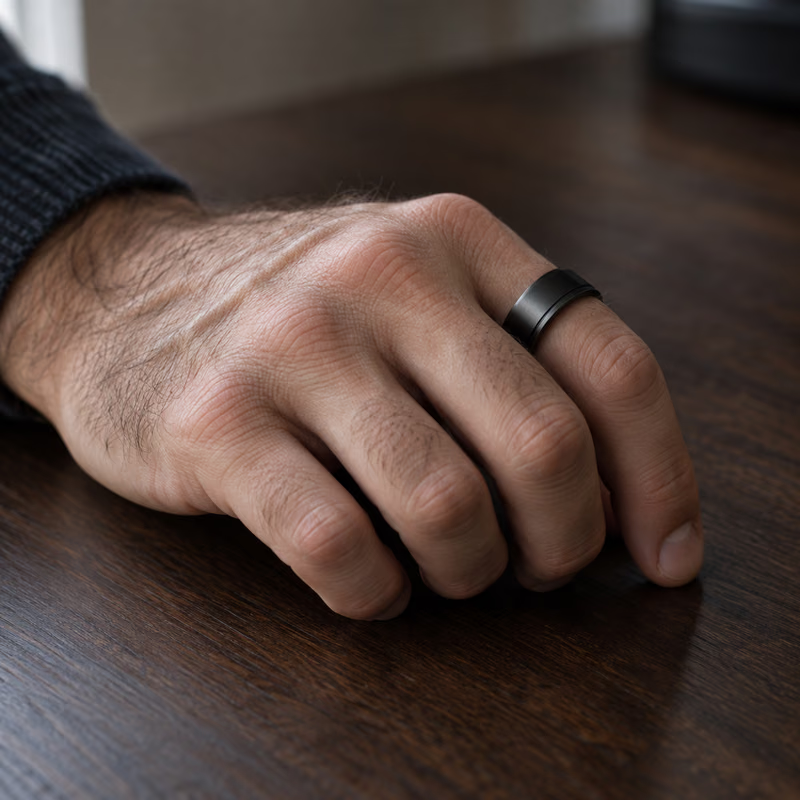
I wear an Oura Ring 5 and I watch two numbers, my resting heart rate overnight and my heart rate variability, which is the beat to beat spacing that tells you which branch of your nervous system is actually in charge. Researchers at the National University of Singapore ran the ring against a hospital ECG through full overnight recordings and found strong agreement for both nighttime heart rate and HRV once the numbers are averaged over half an hour or the whole night. That is the exact window you care about, because the night after the plunge is when your body tells you what the plunge really cost.
The read is simple. Cold that is building you shows up as a resting heart rate that settles back down overnight and an HRV that holds steady or climbs over the weeks. Cold that is digging the hole shows up as a resting heart rate creeping up night after night and an HRV sliding down, and that is the same picture as a system with nothing left to give. If you see that, you have your answer about the adrenals without wondering, and the move is to back off the cold, sleep, eat, put minerals back, and come back to it when the numbers come back. Wear it and forget it, the ring is a nighttime instrument, not something to check while you are standing under the water.
I will be honest with you, because I always will be. A ring is not a medical device and it will not catch a heart problem for you, so it does not replace a good functional medicine doctor if something feels off. What it does is hand you your own trend line instead of your own guesswork, and cold is one of the few practices where that trend line will straight up tell you to stop.
This is a complement to a healthy life, not a cure for anything and not a replacement for medical care.
Why I keep getting in
Beyond the chemistry, there is something the studies do not measure. The cold gives you a small, daily rehearsal for staying calm while your body screams to run. You learn to breathe slow while every instinct says panic, and that skill does not stay in the shower. It follows you into the hard conversation, the deadline, the moment your mind starts to spiral.
The plunge is two minutes of choosing your response instead of your reaction. The sauna teaches stillness in the heat. The cold teaches steadiness in the shock. Together they are some of the best returns on effort in all of wellness, and neither one asks you to buy a thing to start.
Turn the water cold. Breathe. Let your body do what it has always known how to do.